What You See in the Buda Castle Cave
Inside the Buda Castle Cave: limestone caverns left by warm springs, centuries of cellars, a prison, wartime shelters and a mammoth's tooth.
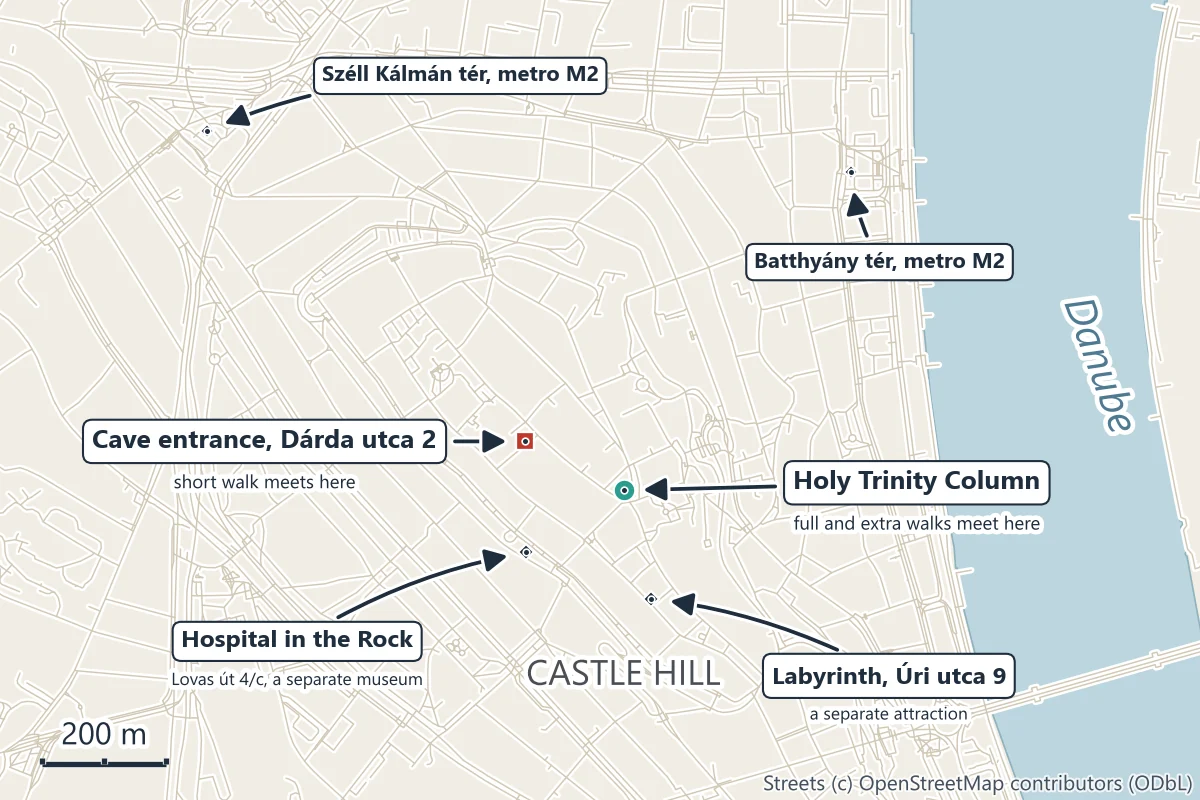
Under the streets of the Buda Castle District runs a cave system of more than 3 km; the national park’s English page gives 3.3 km. It is neither a show cave of dripstones nor a set of dug tunnels, but both at once: natural caverns that warm spring water dissolved in the hill’s rock, which the people living above dug out and joined into a maze of cellars over the centuries. On the national park’s walk you see the natural limestone, fossils and the place where a mammoth left a tooth, and the traces of every later use: wine cellars, a prison, air-raid shelters and an underground party venue. The full walk covers about 1.5 km of it, the short walk about 0.6 km.
The calendar above is the national park’s own walk in English, from US$19 (checked November 2026): the guide covers the geology and the history together, which is the point of this cave.
How the cave formed
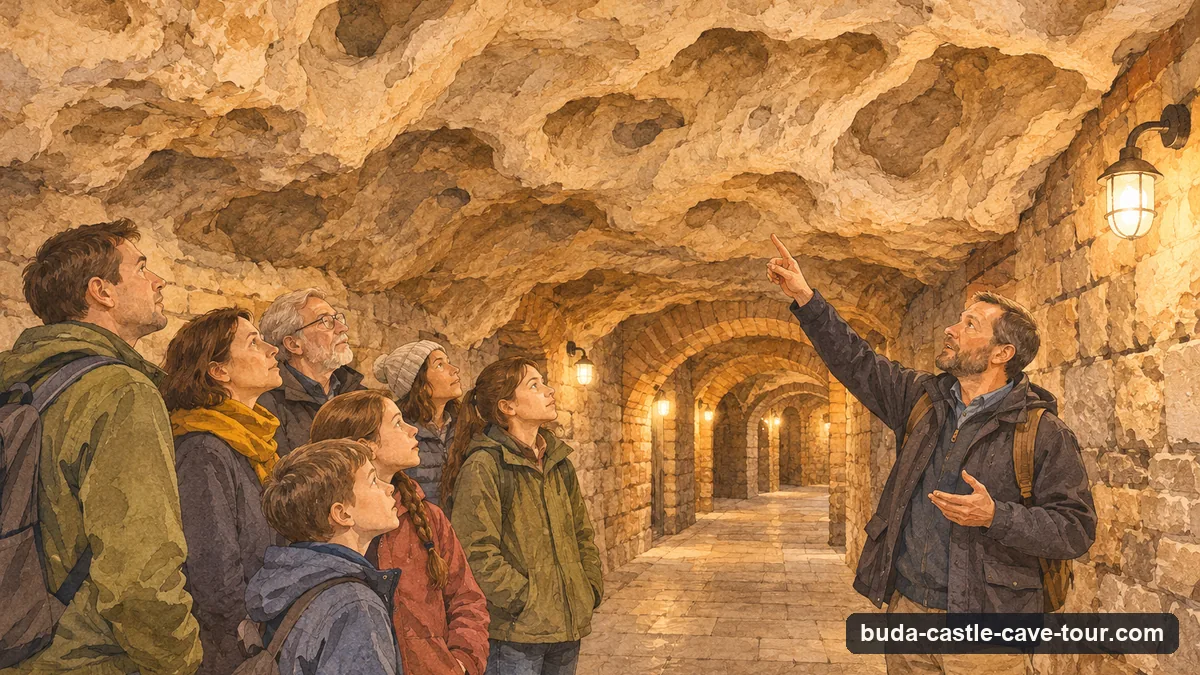
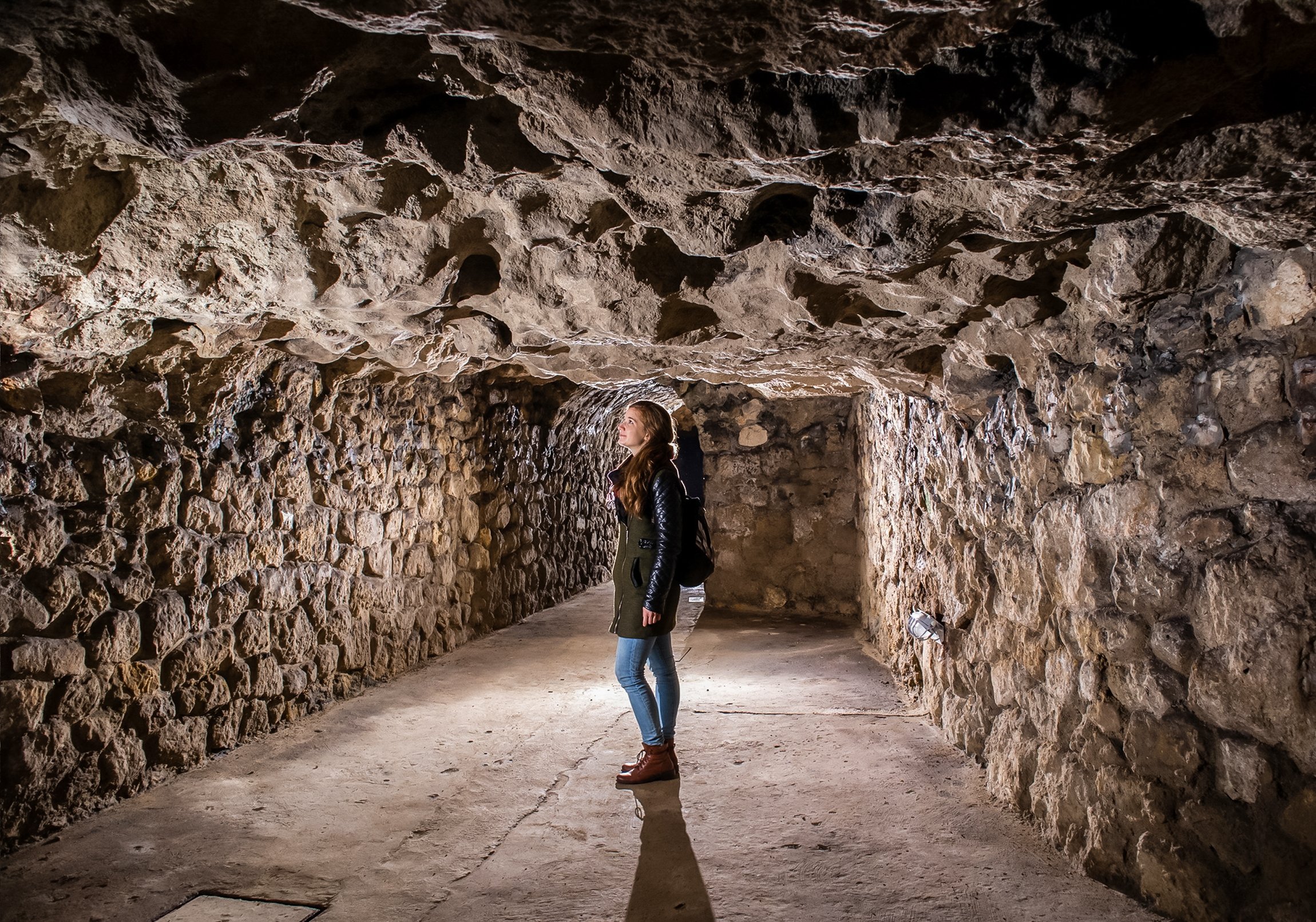
Castle Hill is two kinds of rock stacked on each other. The bulk of the hill is Buda Marl, a clay-rich sedimentary rock. On top of it lies a cap of freshwater limestone, travertine, laid down during the Ice Age by warm springs, when the top of the hill was a marshy area of ponds. Spring water rising through the marl dissolved hollows along the boundary between the two, so the caverns sit just under the limestone: as the Hungarian speleological journal Karszt és Barlang described it in 1967, the ceilings are mostly natural limestone, while the marl side walls were reinforced with stone masonry, and about a fifth of the passages are man-made, most of them dug in the 20th century. Look up as you walk: the round hollows in the limestone ceiling were washed out by swirling spring water.
The animals that came to drink at those ponds left their bones in the limestone as it formed, and the national park’s walk shows where a mammoth left a tooth. The Hospital in the Rock museum, built into another part of the same system, gives the same account of the caves: made by spring water after the glacial period, where the limestone meets the marl.
Geology from the park’s Buda Castle Cave pages (dunaipoly.hu), Kálmán Barátosi’s article “A budai Várbarlang” in the Hungarian speleological journal Karszt és Barlang (1967), and Hospital in the Rock’s history page.
From caverns to cellars
From the Middle Ages the people living on Castle Hill used the caverns under their houses, and over the centuries they dug them out and joined them up, until the natural caves became the labyrinth-like cellar system the park describes. Some of the man-made cellars are about 800 years old.
What the walk shows, in the park’s own list of uses:
- Wine cellars: a steady temperature, about 12°C all year, suits wine.
- A prison: part of the system served as a prison in the Middle Ages.
- Shelters: in the Second World War the cellars became air-raid shelters, and during the siege of Budapest in 1944-45 tens of thousands took refuge in the caves and cellars under the castle.
- An underground party venue: one of its more recent lives.
What it feels like
The walk is on lit, paved paths with few steps and no climbing. It is about 12°C and quiet, with no mobile signal, and your clothes can get muddy if you lean on the walls. It does not suit people with claustrophobia. There are no dripstones to speak of: this is a cave of rock, cellars and history, and the Pál-völgyi Cave in the Buda Hills is the place for stalactites.
The wartime cellars, in more depth
The national park’s walk tells the story of the shelters as part of the whole. For the war on its own, Buda Castle Walks’ 90-minute walk on the siege of 1944-45 starts at Dísz tér 15, goes into the cellar of an old house and an original Second World War bomb shelter in the same cave system, and ends on Szentháromság tér, telling the story from diaries and memoirs of the tens of thousands who sheltered under the castle: see the siege walk, from US$24 (checked November 2026), recommended from age 14.
The emergency hospital built into the cave system in 1941-43, used through the siege and turned into a nuclear bunker in 1958-62, is a separate museum: Hospital in the Rock, on Lovas út. The cave vs the Labyrinth vs Hospital in the Rock explains which is which.
Pick your way underground
Duna-Ipoly National Park: Buda Castle Cave Walk with an English-Speaking Guide
The national park's walk in English: caverns, cellars, the mammoth tooth and the shelters, 40 minutes or 1.5 hours.
Check dates →Buda Castle Walks: The 1944 Siege, a Cellar and a Bomb Shelter in the Castle Cave
Buda Castle Walks: a house cellar and an original bomb shelter in the cave system, told from diaries and memoirs.
See the siege walk →Szemlő-hegyi and Pál-völgyi Caves with a Caving-Association Guide
Szemlő-hegyi and Pál-völgyi in the Buda Hills: mineral crusts, stalactites and crystals.
See the two caves →Prices, ratings and review counts from the listings (GetYourGuide checked November 2026). Providers price by date, so treat the figures as the shape of the market, not a quote.
More Tours with Open Dates
More Budapest Underground Tours with Open Dates
Cave walks, caving and Castle District tours with live availability. Times and cancellation terms are on each listing.
See It with the Park's Guide
The Duna-Ipoly National Park's walk through the Buda Castle Cave, in English: 40 minutes or an hour and a half.
Check dates